PRP for Hair Loss: The Density-vs-Thickness Paradox
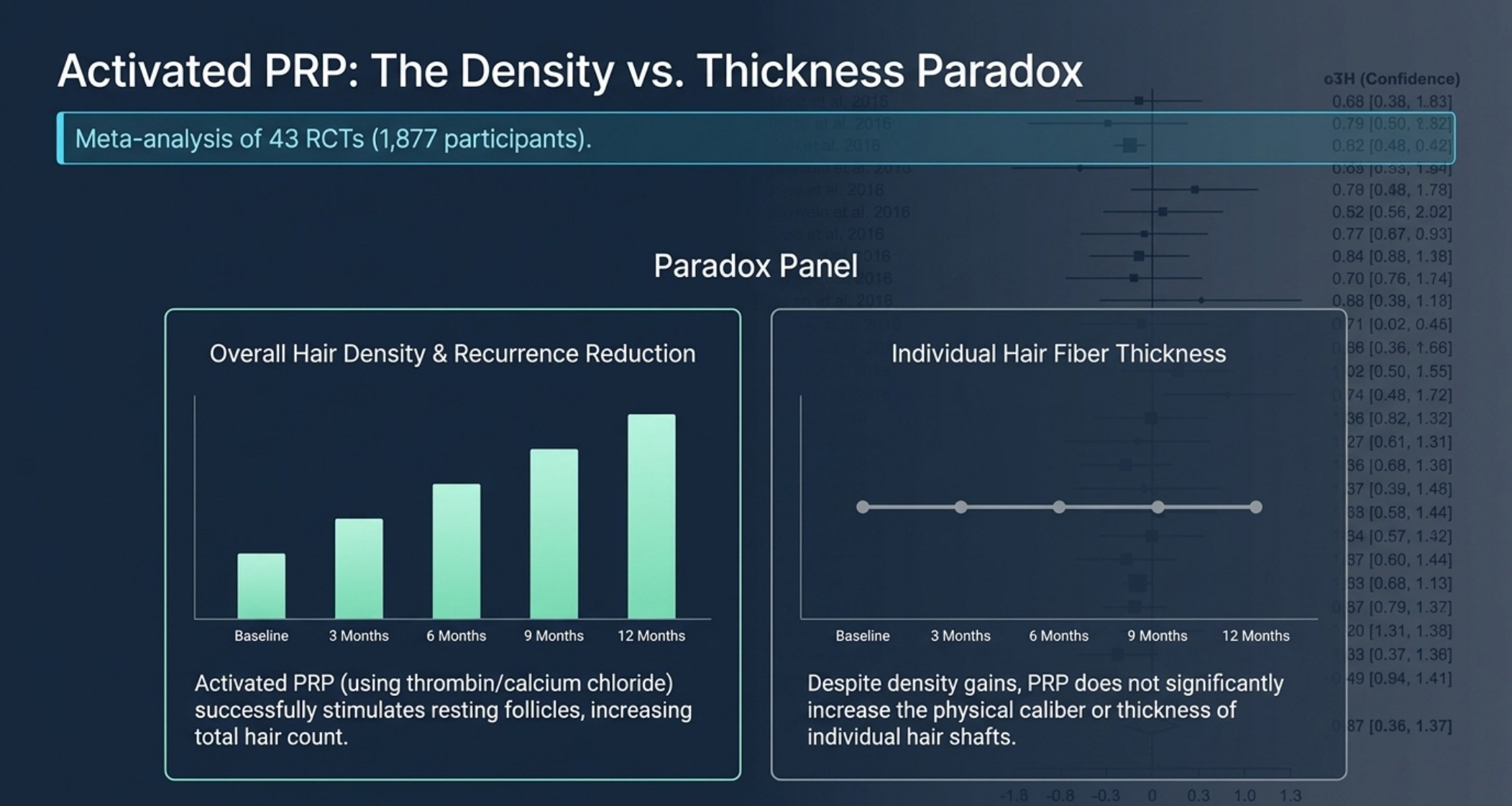
Activated PRP sits in an unusual position in the non-surgical hierarchy: the pooled evidence says it reliably moves density endpoints while leaving individual hair shaft caliber essentially untouched. The meta-analysis reproduced on the slide covers 43 randomised controlled trials and 1,877 participants, and its verdict splits cleanly in two — overall hair density and recurrence reduction improve, but the physical thickness of individual hair shafts does not change significantly. On a 0.3–1.3 effect axis read at baseline, 3, 6, 9 and 12 months, the pooled density estimate lands at 0.77 [0.67, 0.93], an interval that clears 1.0, while thickness-side estimates such as 0.52 [0.56, 2.02] and 0.79 [0.50, 2.82] straddle it. That single distinction decides who should pay for PRP and who should not.
What the 43-RCT Meta-Analysis Actually Measured
The deck synthesises 40+ RCTs and meta-analyses against 2026 dermatological guidelines, and slide 5 isolates the PRP arm from that body of work. "Activated PRP" here means plasma activated with thrombin or calcium chloride rather than simply centrifuged whole plasma, a preparation difference that matters because the growth-factor payload released by activation is the entire mechanism of action. PRP is ranked alongside three other standalone monotherapies: low-level laser therapy at 635–655 nm, 5-alpha reductase inhibitors (oral finasteride 1 mg and dutasteride 0.5 mg) and topical minoxidil at 5% and 2% concentrations.
The meta-analysis tracks two endpoint families on separate panels rather than blending them into one number. The first is hair density and recurrence reduction, meaning how many follicles per unit area are producing hair and how many stay in production. The second is individual hair fibre thickness, the caliber of each shaft. Assessment runs across five timepoints: baseline, 3 months, 6 months, 9 months and 12 months. Reporting both endpoints at all five timepoints is what exposes the paradox that a single composite score would have concealed.
Why Density and Thickness Diverge
The mechanism explains the split. Autologous growth factors delivered by PRP push resting follicles back into the anagen growth phase, which raises the count of actively producing follicles and therefore hair count and density. Caliber is a different problem entirely. Individual shaft thickness is governed by DHT-driven follicular miniaturisation, and PRP delivers no systemic DHT suppression at all. A follicle rescued into anagen will add density; a follicle that has shrunk under DHT exposure will not thicken because growth factors arrived. The two endpoints run on different mechanisms, so they move independently.
The urgency of that distinction comes from the scope numbers in the deck. Androgenetic alopecia accounts for 95% of male hair loss; 85% of men and 33% of women will experience hair loss in their lifetime, which the slide quantifies as roughly 50 million men and 30 million women. The deck is blunt about the biological floor: once a follicle has fully miniaturised it cannot be revived through medical therapy alone, and early intervention is the only defence. A density-only intervention therefore loses value as miniaturisation advances, because fewer rescueable follicles remain to recruit.
Reading the Confidence Intervals
Every pooled estimate on the slide is reported with a bracket. When an interval crosses 1.0 the result does not reach significance at that endpoint, and the practical reading is that the change cannot be promised. The density figure of 0.77 [0.67, 0.93] stays clear of 1.0, which is the numeric basis for calling PRP a density intervention. The thickness-side estimates do not hold that line — intervals such as 0.68 [0.38, 1.83], 0.79 [0.50, 2.82] and 0.78 [0.48, 1.78] all include 1.0, which is precisely what the written conclusion on the slide states: density gains without a significant increase in physical caliber. For a broader cross-check of how such estimates rank against other agents, the efficacy scale breakdown walks the same scale slide by slide.
| Reported estimate | Interval spans 1.0? | Endpoint reading |
|---|---|---|
| 0.77 [0.67, 0.93] | No — stays above 1.0 | Density and recurrence reduction reach significance |
| 0.68 [0.38, 1.83] | Yes | Does not reach significance |
| 0.79 [0.50, 2.82] | Yes | Does not reach significance |
| 0.78 [0.48, 1.78] | Yes | Does not reach significance |
| 0.84 [0.88, 1.38] | Yes | Does not reach significance |
| 0.52 [0.56, 2.02] | Yes | Does not reach significance |
Benchmarks Against the Other Monotherapies
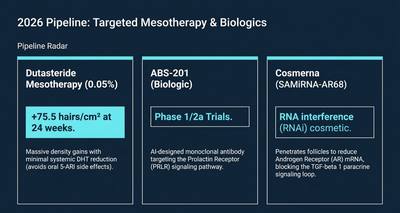
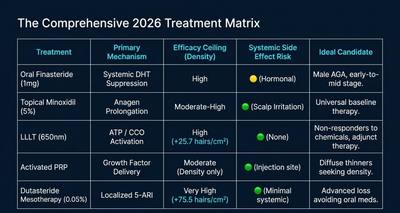
PRP does not compete in an empty field, and the deck reports hard hair-count figures for the alternatives. Low-level laser therapy at 635–655 nm produces a +18.4 to +25.7 hairs/cm² increase at 26 weeks, with a +39% hair count increase in males and +37% in females across the Harvard DASH and Lanzafame RCTs. The pipeline candidate dutasteride mesotherapy at 0.05% is reported at +75.5 hairs/cm² at 24 weeks. Against those figures PRP produces a real but not dominant density movement, and its missing caliber effect is the reason it is best read as one lane of a protocol rather than a standalone answer. An Irvine case that stacks PRP with a 5-ARI is therefore comparing a density-only result against a device result of +25.7 hairs/cm² and a systemic agent with no count published on this slide. The clinical regrowth science overview covers how these agents get combined.
| Agent | Mechanism | Reported result | Timepoint |
|---|---|---|---|
| Dutasteride mesotherapy 0.05% | Localised 5-ARI | +75.5 hairs/cm² | 24 weeks |
| LLLT 635-655 nm | Photobiomodulation / ATP | +18.4 to +25.7 hairs/cm² | 26 weeks |
| LLLT 635-655 nm | Photobiomodulation | +39% hair count (males), +37% (females) | Harvard DASH / Lanzafame RCTs |
| Activated PRP | Autologous growth factors | Density gain; no significant caliber change | Baseline to 12 months |
| Topical minoxidil 5% / 2% | Vasodilation / anagen prolongation | Universal baseline therapy | Not stated on slide |
| Oral finasteride 1 mg / dutasteride 0.5 mg | Systemic DHT suppression | High efficacy ceiling (density) | Not stated on slide |
| Matrix field | Slide answer |
|---|---|
| Ideal candidate | Diffuse thinners seeking density |
| Efficacy ceiling (density) | Moderate, flagged density only |
| Systemic side-effect risk | Injection site |
| Thickness endpoint | No significant increase in physical caliber |
| Evidence base | Meta-analysis of 43 RCTs, 1,877 participants |
| Timepoints assessed | Baseline, 3, 6, 9 and 12 months |
Who Is a Rational PRP Candidate
The deck's comprehensive matrix gives PRP a moderate efficacy ceiling, explicitly flagged "density only", with an injection-site risk profile and one named ideal candidate: diffuse thinners seeking density. That is a narrower indication than the marketing around PRP suggests. A diffuse thinner whose follicles are still cycling has material to recruit, so a density intervention has somewhere to land. A patient whose follicles are already fully miniaturised falls under the deck's biological floor rule and should be evaluating a different lane entirely. In Irvine, and across California more broadly, the practical filter is identical: confirm the follicles you want to add density to are still capable of producing hair before committing to a series of injections.
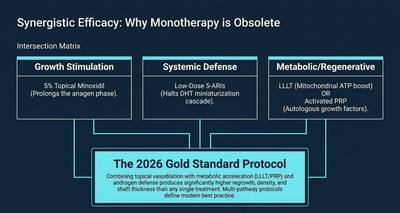
Cost and session structure are the other half of the decision. Because PRP delivers no systemic DHT suppression it does not replace a 5-ARI; it stacks with one, which means the honest budget comparison is PRP plus baseline therapy against the alternatives rather than PRP in isolation. The treatment finder tools and the head-to-head comparisons let you model that stack against minoxidil, LLLT and 5-ARI options before booking anything.
Frequently Asked Questions
Does PRP make individual hairs thicker?
According to the meta-analysis on the slide — 43 RCTs covering 1,877 participants — no. PRP does not significantly increase the physical caliber or thickness of individual hair shafts, and thickness-side intervals such as 0.68 [0.38, 1.83] and 0.79 [0.50, 2.82] cross 1.0. Its measurable effect is on density, where the pooled estimate is 0.77 [0.67, 0.93].
How long before a density change can be judged?
The meta-analysis assesses outcomes at baseline, 3, 6, 9 and 12 months. The full 12-month reading is the honest review point, because the 3-month and 6-month timepoints sit inside the early window of anagen recruitment.
Can PRP replace a DHT-suppressing medication?
No. PRP delivers autologous growth factors, not systemic DHT suppression, so it addresses density rather than the miniaturisation cascade. Oral finasteride at 1 mg and dutasteride at 0.5 mg are the agents in the deck that act on DHT. This is educational information, not medical advice, and a qualified provider should assess the individual case.
Get matched with hair restoration professionals →
Ready for a Professional Review?
We can connect you with qualified hair restoration professionals who can map your situation to the right treatment.
Get Matched with Hair Restoration Professionals