Why Monotherapy Is Obsolete: Combination Protocols
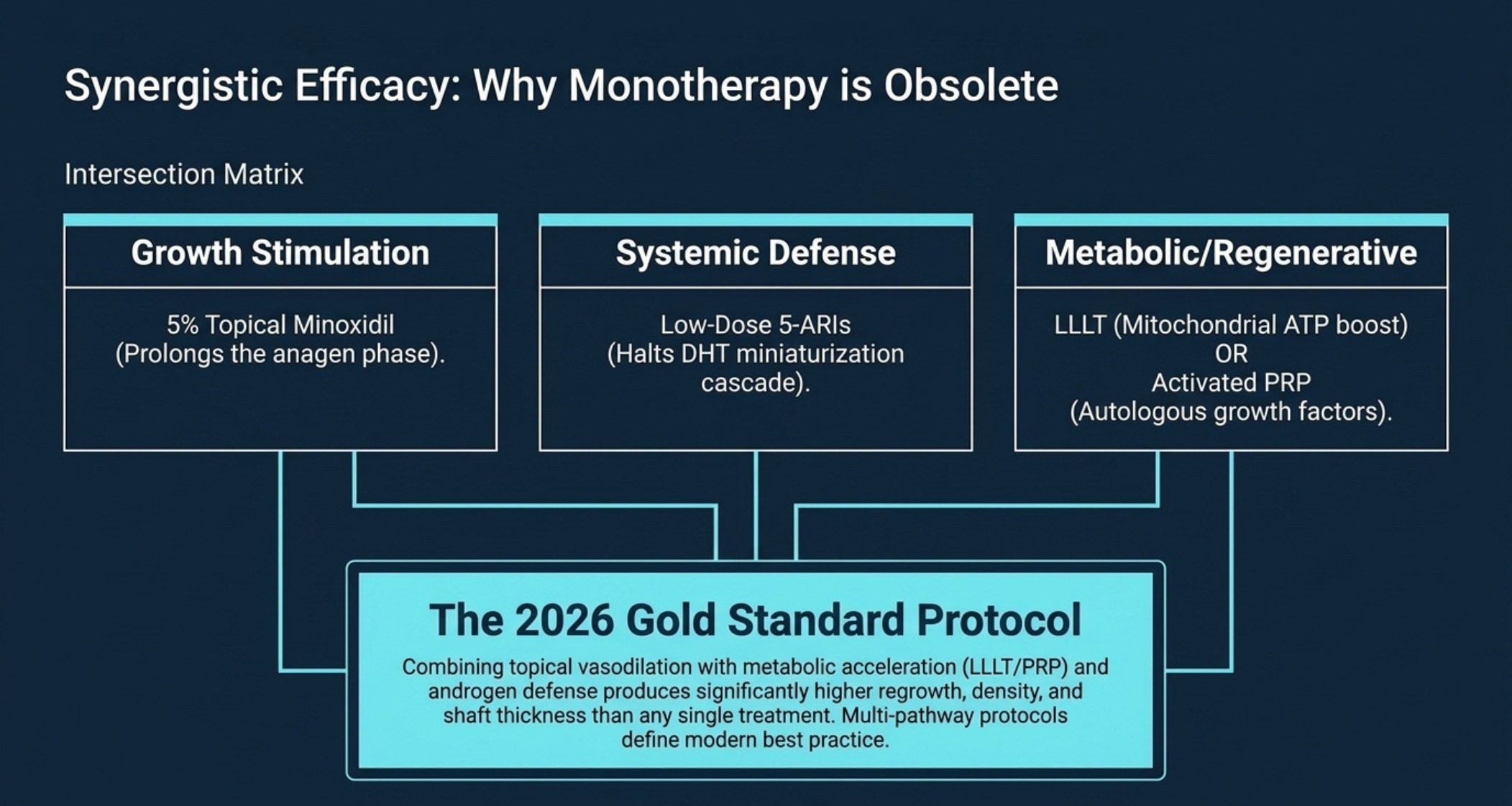
The slide's intersection matrix divides non-surgical treatment into three lanes that do not overlap: growth stimulation (5% topical minoxidil, which prolongs the anagen phase), systemic defence (low-dose 5-ARIs, which halt the DHT miniaturisation cascade), and metabolic or regenerative support (LLLT as a mitochondrial ATP boost, or activated PRP as autologous growth factors). No single lane covers all three jobs, which is the numeric reason the deck calls monotherapy obsolete. The 2026 gold-standard protocol combines topical vasodilation with metabolic acceleration and systemic defence, and the slide's stated claim is that this multi-pathway approach produces greater density and shaft thickness than any single treatment.
The Three Lanes, and What Each One Cannot Do
Growth stimulation is the minoxidil lane. Topical minoxidil at 5% and 2% works by vasodilation and anagen prolongation, and the deck rates it moderate-to-high on efficacy ceiling with scalp irritation as its risk. It buys time in the growth phase but does nothing about the androgen signal shortening that phase in the first place. Systemic defence is the 5-ARI lane: oral finasteride at 1 mg and dutasteride at 0.5 mg suppress DHT, and the matrix rates both high, with finasteride carrying a hormonal risk flag. That lane addresses the cause but does not independently maximise count. Metabolic and regenerative support is the third lane: LLLT at 635–655 nm activates cytochrome c oxidase and mitochondrial ATP, and activated PRP delivers autologous growth factors.
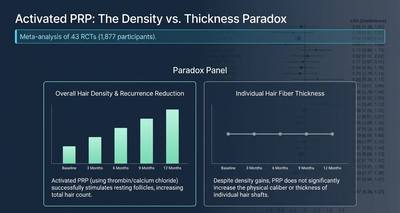
The lanes are mechanically separate, which is what makes stacking rational rather than redundant. PRP's drawback is the mirror image of its strength: at a moderate efficacy ceiling and flagged density only, it does not thicken individual shafts, because caliber is governed by DHT and PRP does not suppress DHT. Minoxidil cannot substitute for that suppression, and a 5-ARI cannot generate the growth-factor signal PRP provides. Each agent's ceiling is set by what its mechanism can reach, and no mechanism on the slide reaches all three.
What Each Lane Delivers in Numbers
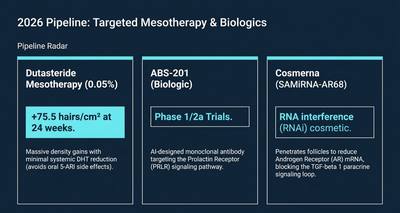
The quantified lane is the metabolic one. LLLT at 635–655 nm delivers +18.4 to +25.7 hairs/cm² at 26 weeks, with a +39% hair count increase in males and +37% in females across the Harvard DASH and Lanzafame RCTs. On the systemic side, the pipeline candidate dutasteride mesotherapy at 0.05% is reported at +75.5 hairs/cm² at 24 weeks, rated very high with minimal systemic effect. PRP, by contrast, carries a meta-analysis of 43 RCTs spanning 1,877 participants whose pooled density estimate sits at 0.77 [0.67, 0.93] while thickness-side intervals cross 1.0. Read together, those figures show three agents with three different strengths, none of them substitutable for another.
| Lane | Agent | Mechanism | Efficacy ceiling | What it cannot do |
|---|---|---|---|---|
| Growth stimulation | 5% topical minoxidil | Vasodilation / prolongs anagen phase | Moderate-high | Does not suppress DHT |
| Systemic defence | Low-dose 5-ARIs (finasteride 1 mg, dutasteride 0.5 mg) | Halts the DHT miniaturisation cascade | High | Does not add growth-factor signal |
| Metabolic / regenerative | LLLT 635-655 nm | Mitochondrial ATP boost | High | Does not suppress DHT |
| Metabolic / regenerative | Activated PRP | Autologous growth factors | Moderate (density only) | Does not change shaft caliber |
The scope numbers explain why the deck treats the systemic lane as non-optional rather than additive. Androgenetic alopecia accounts for 95% of male hair loss, and 85% of men and 33% of women will experience hair loss in their lifetime, which the slide expresses as roughly 50 million men and 30 million women. The deck's biological floor rule states that once a follicle has fully miniaturised it cannot be revived through medical therapy alone, so early intervention is the only defence. Prolonging the anagen phase and accelerating metabolism do not stop the miniaturisation cascade; only the systemic lane does. That is the asymmetry that makes combination the default.
| Agent | Reported result | Timepoint | Endpoint type |
|---|---|---|---|
| Dutasteride mesotherapy 0.05% | +75.5 hairs/cm² | 24 weeks | Density |
| LLLT 635-655 nm | +18.4 to +25.7 hairs/cm² | 26 weeks | Density |
| LLLT 635-655 nm | +39% males, +37% females hair count | Harvard DASH / Lanzafame RCTs | Density |
| Activated PRP | 0.77 [0.67, 0.93]; thickness intervals cross 1.0 | Baseline to 12 months | Density only, not caliber |
| Topical minoxidil 5% | Universal baseline therapy | Not stated | Anagen prolongation |
| Oral finasteride 1 mg / dutasteride 0.5 mg | High efficacy ceiling | Not stated | Systemic DHT suppression |
Why Stacking Beats Switching
Switching agents resets the clock on whatever the previous lane was doing. Stop a 5-ARI and systemic DHT suppression lapses, which lets the miniaturisation cascade resume against every follicle in the androgen-sensitive pattern. Stop minoxidil and the anagen prolongation it was buying disappears across the entire treated area at once, not gradually. Because LLLT and PRP act on metabolic and regenerative endpoints while a 5-ARI acts on DHT and minoxidil acts on the growth phase, adding a lane does not dilute the others. The slide's intersection matrix is drawn as three non-overlapping circles precisely to make that point: the value comes from the union of the lanes, not from picking the strongest circle.
The sequencing question is therefore a budget and tolerance question, not a mechanism question. A reasonable build order follows the risk column on the matrix: start with the systemic lane if the patient is a candidate for it, because it addresses the mechanism that drives the loss; add the topical baseline because it is universal; then layer LLLT or PRP where the patient has a specific gap, such as non-response to chemicals or a need for density. The how-it-works walkthrough maps that sequence against the matrix.
Sequencing and Side-Effect Budgets
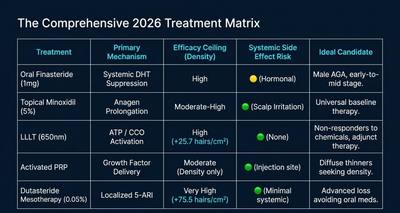
Every lane carries a cost in the risk column, and stacking lanes means stacking risks. Finasteride at 1 mg carries a hormonal systemic risk flag; minoxidil carries scalp irritation; PRP carries injection-site risk; LLLT is listed with no systemic risk; dutasteride mesotherapy carries minimal systemic risk. A combination protocol is not free of trade-offs simply because each component is individually tolerable. The slide's matrix makes the arithmetic visible so a protocol can be assembled around the risks a given patient will accept rather than around a single headline efficacy number.
| Agent | Systemic effect risk | Local / other risk | Role in a stack |
|---|---|---|---|
| LLLT 650 nm | None | Not listed | Adjunct for chemical non-responders |
| Dutasteride mesotherapy 0.05% | Minimal | Injection site | Localised systemic defence |
| Oral finasteride 1 mg | Hormonal | Not listed | Systemic DHT suppression |
| Activated PRP | Not listed | Injection site | Density only |
| Topical minoxidil 5% | Not listed | Scalp irritation | Universal baseline |
Building the Protocol for Early Versus Advanced Loss
Stage decides the mix, because the matrix's ideal-candidate column is stage-dependent. For early-to-mid male androgenetic alopecia, oral finasteride at 1 mg is the named match at a high efficacy ceiling, with topical minoxidil at 5% as the universal baseline and LLLT as an adjunct where chemicals do not respond. For advanced loss in a patient avoiding oral medication, the matrix points to dutasteride mesotherapy at 0.05%, which is rated very high at +75.5 hairs/cm² with minimal systemic risk. Diffuse thinners seeking density are matched to PRP at a moderate ceiling, flagged density only.
In Irvine and throughout California, the practical reason to build the stack deliberately is that the density-only and caliber-only endpoints do not cover each other. A protocol that suppresses DHT and adds growth-factor signal and prolongs anagen is doing three things at once, and the slide's position is that this is what defines best practice in 2026. The treatment comparisons and the efficacy scale ranking are where those per-lane ceilings get placed side by side.
Frequently Asked Questions
Do I have to pick one treatment?
The slide's position is that you should not. Multi-pathway protocols define best practice because topical vasodilation, metabolic acceleration (LLLT or PRP) and systemic defence act on three separate mechanisms, and the combined protocol is stated to produce greater density and shaft thickness than any single treatment.
Why do single-agent protocols underperform?
Because each lane has a ceiling set by its mechanism. PRP is rated moderate and density only and does not change shaft caliber; LLLT delivers +18.4 to +25.7 hairs/cm² at 26 weeks but no DHT suppression; finasteride and dutasteride suppress DHT but add no growth-factor signal. None of the three reaches the other two endpoints.
Where should an Irvine patient start?
With the stage. Early-to-mid male androgenetic alopecia maps to oral finasteride at 1 mg, with minoxidil 5% as the universal baseline and LLLT as an adjunct for chemical non-responders. Advanced loss in someone avoiding oral medication maps to dutasteride mesotherapy at 0.05% at +75.5 hairs/cm² and minimal systemic risk. This is educational information, not medical advice, and a qualified provider should assess the individual case.
Get matched with hair restoration professionals →
Ready for a Professional Review?
We can connect you with qualified hair restoration professionals who can map your situation to the right treatment.
Get Matched with Hair Restoration Professionals