The 2026 Hair Loss Treatment Decision Matrix
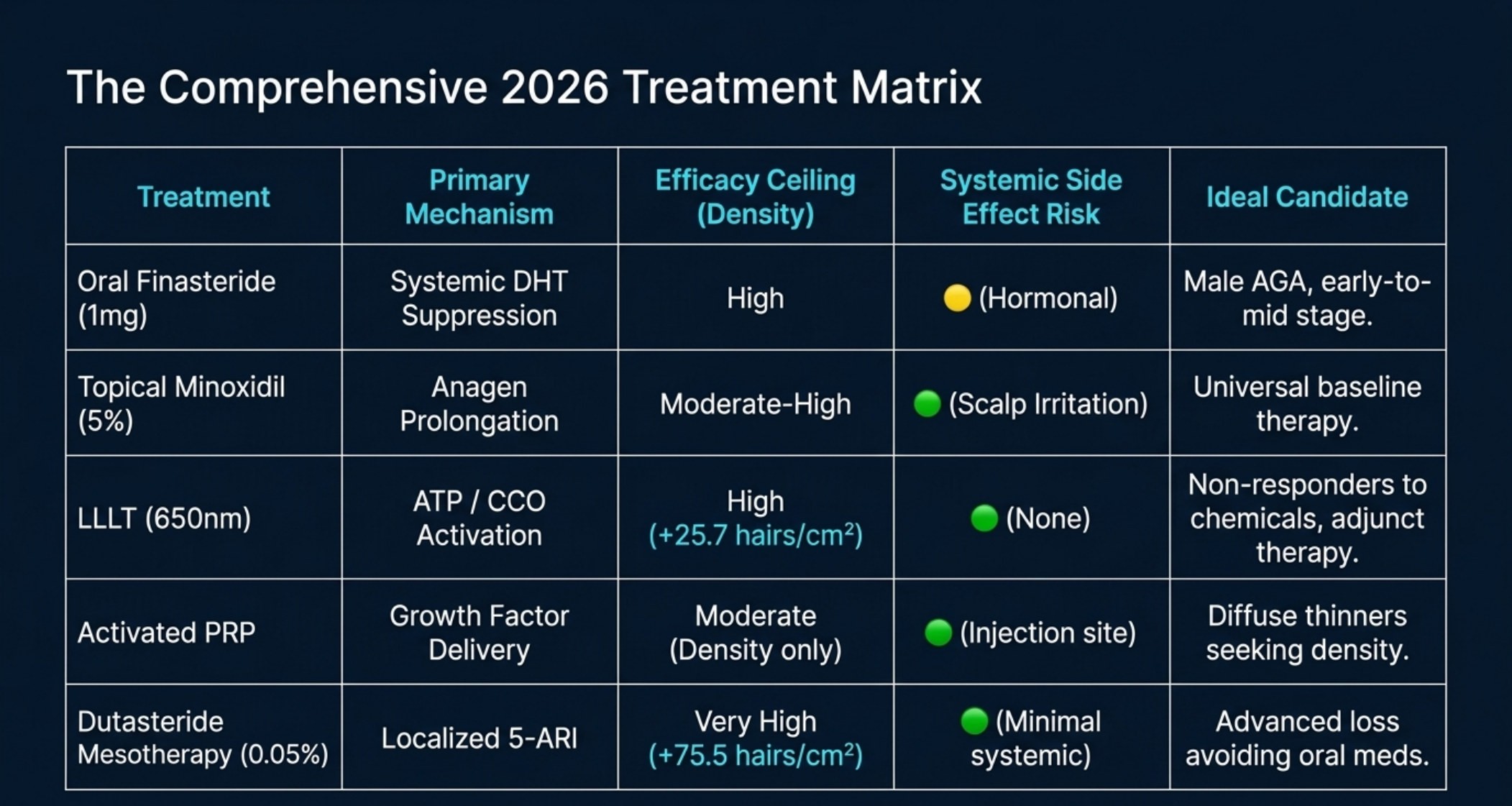
The comprehensive 2026 matrix on the slide maps five treatment options against five columns: primary mechanism, efficacy ceiling on density, ideal candidate, and systemic side-effect risk. Read across the rows and the ranking is explicit. Oral finasteride at 1 mg is systemic DHT suppression at a high ceiling for early-to-mid male androgenetic alopecia, flagged hormonal. Topical minoxidil at 5% is anagen prolongation at moderate-high, the universal baseline, flagged for scalp irritation. LLLT at 650 nm is ATP and cytochrome c oxidase activation at a high ceiling, quantified at +25.7 hairs/cm², with no systemic risk. Activated PRP is growth-factor delivery at moderate, explicitly density only, flagged for injection site. Dutasteride mesotherapy at 0.05% is a localized 5-ARI at a very high ceiling, quantified at +75.5 hairs/cm², with minimal systemic risk.
Reading the Matrix Column by Column
The mechanism column is what makes the matrix a decision tool rather than a ranking. Finasteride and dutasteride mesotherapy both act on the 5-alpha reductase pathway, but the oral route is systemic and the mesotherapy route is localized, which is why they occupy different rows with different risk flags despite sharing a mechanism family. Minoxidil works by vasodilation and anagen prolongation; LLLT works by photobiomodulation, photodissociating nitric oxide from cytochrome c oxidase (Complex IV) to boost mitochondrial ATP; PRP works by delivering autologous growth factors. Four distinct mechanisms across five rows mean four distinct ceiling values.
The ideal-candidate column is the filter that most patients will use first, and it is deliberately narrow in places. Finasteride is matched to male androgenetic alopecia in early-to-mid stage, not to advanced loss. Minoxidil is matched to nobody in particular because it is the universal baseline. LLLT is matched to non-responders to chemicals and as adjunct therapy. PRP is matched to diffuse thinners seeking density. Dutasteride mesotherapy is matched to advanced loss in patients avoiding oral medication. Stage and tolerance drive the match more than headline efficacy does.
Efficacy Ceilings Ranked
Ranked on the matrix's density ceiling, dutasteride mesotherapy at 0.05% sits at the top as very high, with its +75.5 hairs/cm² figure attached. Oral finasteride at 1 mg and LLLT at 650 nm both sit at high, and LLLT is the only one of the two carrying a hard number at +25.7 hairs/cm². Topical minoxidil at 5% is moderate-high, and activated PRP is moderate with the explicit qualifier that its benefit is density only. That ordering is a ceiling ranking, not a recommendation sequence, because a higher ceiling on a treatment a patient cannot tolerate is worth less than a lower ceiling on one they can.
| Treatment | Primary mechanism | Efficacy ceiling (density) | Ideal candidate | Systemic side-effect risk |
|---|---|---|---|---|
| Dutasteride mesotherapy 0.05% | Localized 5-ARI | Very high (+75.5 hairs/cm²) | Advanced loss avoiding oral meds | Minimal systemic |
| Oral finasteride 1 mg | Systemic DHT suppression | High | Male AGA, early-to-mid stage | Hormonal |
| LLLT 650 nm | ATP / cytochrome c oxidase activation | High (+25.7 hairs/cm²) | Chemical non-responders; adjunct therapy | None |
| Topical minoxidil 5% | Anagen prolongation | Moderate-high | Universal baseline therapy | Scalp irritation |
| Activated PRP | Growth factor delivery | Moderate (density only) | Diffuse thinners seeking density | Injection site |
Matching Candidate to Stage
Stage carries more weight than preference in this matrix, because the deck states a biological floor: once a follicle has fully miniaturised it cannot be revived through medical therapy alone, and early intervention is the only defence. The scope numbers behind that rule are large — androgenetic alopecia accounts for 95% of male hair loss, and 85% of men and 33% of women will experience hair loss in their lifetime, which the slide quantifies as roughly 50 million men and 30 million women. A patient in the early-to-mid window still has follicles that respond to systemic DHT suppression, which is why finasteride at 1 mg is the named match there. A patient presenting with advanced loss has less responsive tissue, which is why the matrix shifts that row toward a localized, higher-ceiling option.
| Presentation | Matched treatment | Stated ceiling | Named reason |
|---|---|---|---|
| Male AGA, early-to-mid stage | Oral finasteride 1 mg | High | Systemic DHT suppression while follicles still respond |
| Advanced loss, avoiding oral medication | Dutasteride mesotherapy 0.05% | Very high (+75.5 hairs/cm²) | Localized 5-ARI, minimal systemic effect |
| Universal baseline | Topical minoxidil 5% | Moderate-high | Anagen prolongation for any candidate |
| Non-responders to chemicals | LLLT 650 nm | High (+25.7 hairs/cm²) | ATP activation, no systemic risk |
| Diffuse thinners seeking density | Activated PRP | Moderate (density only) | Growth factor delivery to cycling follicles |
Side-Effect Risk as a Selection Variable
The risk column changes the ranking for real patients. Finasteride at 1 mg carries a hormonal systemic flag, which is the reason the matrix offers a localized 5-ARI row at all; dutasteride mesotherapy at 0.05% achieves its very high ceiling with minimal systemic effect, and that trade-off is the entire point of the row. LLLT at 650 nm is the only entry listed with no systemic risk, and its ceiling is still high at +25.7 hairs/cm². Minoxidil's cost is local, scalp irritation, and PRP's is injection site. For an Irvine patient who wants the very high ceiling but cannot accept a hormonal flag, the localized 5-ARI row at +75.5 hairs/cm² and minimal systemic effect is the direct substitute. There is no row with both the highest ceiling and the cleanest risk profile, which is why the deck elsewhere frames the answer as stacking lanes rather than choosing one.
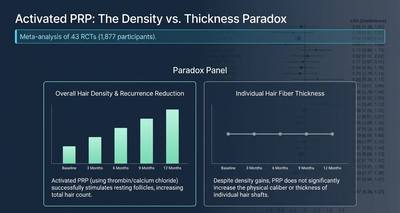
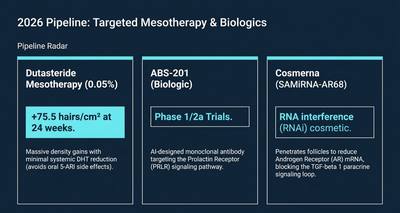
Two constraints also sit outside the risk column and belong in any real decision. The first is timepoint discipline: mesotherapy's +75.5 hairs/cm² is measured at 24 weeks, LLLT's +18.4 to +25.7 at 26 weeks, and PRP's density endpoint out to 12 months, so a like-for-like comparison has to hold the horizon fixed. The second is evidence class: the PRP row rests on a meta-analysis of 43 RCTs covering 1,877 participants, while the deck's foundation is 40+ RCTs and meta-analyses, and a Phase 1/2a candidate does not sit at that level. The comparison pages hold those columns side by side.
| Treatment | Quantified result | Timepoint | Evidence class on the slide |
|---|---|---|---|
| Dutasteride mesotherapy 0.05% | +75.5 hairs/cm² | 24 weeks | Pipeline / targeted mesotherapy |
| LLLT 635-655 nm | +18.4 to +25.7 hairs/cm² | 26 weeks | Harvard DASH / Lanzafame RCTs |
| Activated PRP | 0.77 [0.67, 0.93] density estimate | Baseline to 12 months | Meta-analysis of 43 RCTs (1,877 participants) |
| Oral finasteride 1 mg / dutasteride 0.5 mg | No count listed | Not stated | Standalone monotherapy ranking |
| Topical minoxidil 5% / 2% | No count listed | Not stated | Universal baseline therapy |
Turning the Matrix Into a Decision
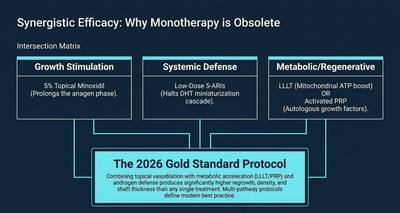
The matrix resolves into a short sequence. Confirm the stage first, because that determines whether the early-to-mid finasteride row is available to the patient or whether the advanced-loss row is the realistic entry point. Confirm tolerance second, because the hormonal flag on finasteride and the localized alternative at very high ceiling is the single largest fork in the table. Establish the universal baseline third, since minoxidil at 5% is matched to every candidate and its only flagged cost is scalp irritation. Then add the adjunct whose mechanism fills the specific gap: LLLT at +25.7 hairs/cm² for chemical non-responders, or PRP for density in diffuse thinners.
That sequence is why the matrix pairs so naturally with a stacking protocol and why the Irvine or California consultation is about stage and tolerance rather than about which single product is strongest. The how-it-works guide and the interactive decision tools are built to run exactly this stage-and-tolerance filter, and you can request a matched review once the row is identified.
Frequently Asked Questions
Which treatment has the highest efficacy ceiling?
On the slide's matrix, dutasteride mesotherapy at 0.05% is rated very high, with +75.5 hairs/cm² reported. Oral finasteride at 1 mg and LLLT at 650 nm follow at high, with LLLT quantified at +25.7 hairs/cm². Topical minoxidil 5% is moderate-high and activated PRP is moderate, flagged density only.
Which option has no systemic side-effect risk?
LLLT at 650 nm is the only row on the matrix listed with no systemic risk. PRP's flagged risk is injection site, minoxidil's is scalp irritation, dutasteride mesotherapy's is minimal systemic, and finasteride's is hormonal.
Who is minoxidil actually for?
The matrix names topical minoxidil at 5% as universal baseline therapy, meaning it is not limited by stage or candidate type the way the other rows are. Its stated ceiling is moderate-high and its flagged cost is scalp irritation. This is educational information, not medical advice, and a qualified provider should assess the individual case.
Get matched with hair restoration professionals →
Ready for a Professional Review?
We can connect you with qualified hair restoration professionals who can map your situation to the right treatment.
Get Matched with Hair Restoration Professionals