The 2026 Pipeline: Mesotherapy, siRNA and Biologics
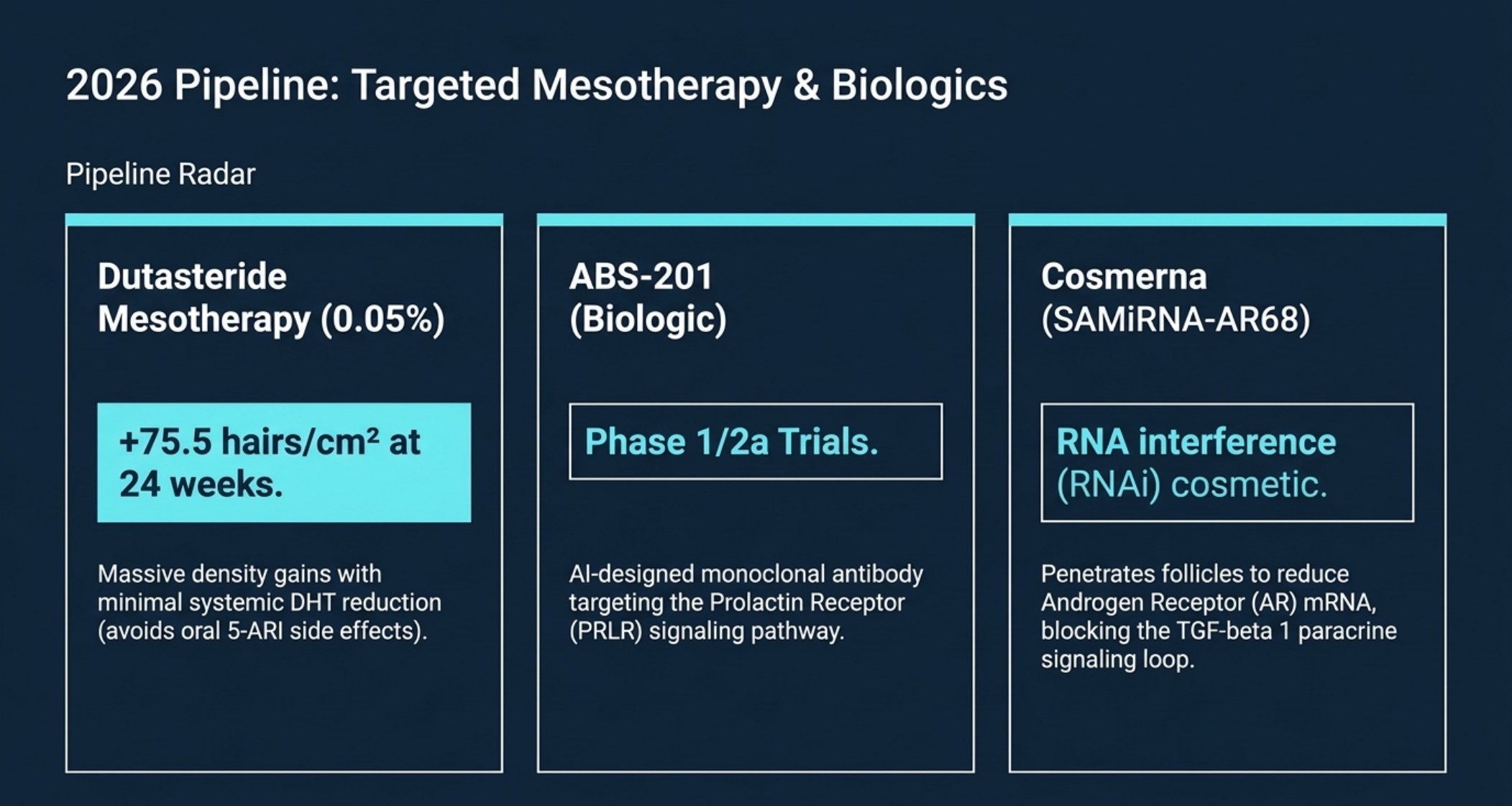
Three candidates define the 2026 pipeline on the slide, and one of them already carries a hard hair-count number. Dutasteride mesotherapy at a 0.05% concentration is reported at +75.5 hairs/cm² at 24 weeks with minimal systemic DHT reduction. Alongside it sit ABS-201, an AI-designed monoclonal antibody targeting the prolactin receptor (PRLR) signalling pathway in Phase 1/2a trials, and Cosmerna (SAMiRNA-AR68), an RNA-interference cosmetic that penetrates follicles to reduce androgen receptor (AR) mRNA. The trade-off uniting all three is the same: get local density movement without the systemic exposure of an oral 5-ARI.
Dutasteride Mesotherapy: The Only Pipeline Entry With a Count
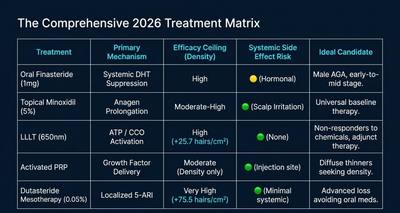
Dutasteride mesotherapy at 0.05% is the pipeline entry the deck can quantify. The reported result is +75.5 hairs/cm² at 24 weeks, delivered by a localised 5-alpha reductase inhibitor rather than a systemic tablet. The comprehensive matrix rates its efficacy ceiling as very high and its systemic effect risk as minimal, with one named ideal candidate: advanced loss in patients avoiding oral medication. That framing matters, because it separates the drug from its delivery route. Oral dutasteride at 0.5 mg suppresses DHT systemically; the mesotherapy route targets the scalp. The slide's claim is that this localization buys substantial density gain while avoiding the oral 5-ARI side-effect profile.
Read the number against its comparator class honestly. The approved oral agents in the same matrix are finasteride at 1 mg and dutasteride at 0.5 mg, both rated high on efficacy ceiling, with finasteride carrying a hormonal systemic side-effect flag. Mesotherapy is rated above them at very high, but it is the least established route on the slide, and a 24-week endpoint is a short window compared with the 12-month follow-up used for PRP. A watch list of emerging options is the right way to hold a result like this until longer datasets land.
ABS-201: Targeting the Prolactin Receptor
ABS-201 is described on the slide as an AI-designed monoclonal antibody directed at the prolactin receptor (PRLR) signalling pathway, currently in Phase 1/2a trials. That is a genuinely different target from the androgen axis. Finasteride and dutasteride both act by suppressing DHT conversion; ABS-201 is engineered against a receptor-level signalling pathway, which is why the slide groups it under biologics rather than under 5-ARIs.
The honest limitation is that the slide lists a stage, not an efficacy endpoint. There is no hair-count figure attached to ABS-201 here, and no percentage change. That is the normal state of Phase 1/2a research, and it is a reason to treat the candidate as directional rather than actionable. A believable protocol decision needs a measured hairs/cm² movement at a fixed timepoint, the way dutasteride mesotherapy has one at 24 weeks and LLLT has one at 26 weeks. Until ABS-201 carries a comparable number, it belongs in a monitoring list rather than a treatment plan.
Cosmerna (SAMiRNA-AR68): RNA Interference at the Follicle
Cosmerna, also written SAMiRNA-AR68, is classified on the slide as an RNA interference (RNAi) cosmetic. Its described mechanism is penetration into follicles to reduce androgen receptor (AR) mRNA, which blocks the TGF-beta 1 paracrine signalling loop. That is a topical, follicle-level attack on the androgen signalling chain rather than a systemic suppression of DHT production, and it is why the slide places it in the pipeline section beside mesotherapy rather than among the approved monotherapies.
The label "cosmetic" is the operative qualifier. It signals a regulatory and evidence category distinct from a prescription therapy, and the slide reports no hair-count movement for it — no hairs/cm², no percentage, no timepoint. Cosmerna's interest lies in its target: AR mRNA reduction inside the follicle is mechanistically adjacent to what ABS-201 attempts at the receptor, approached through RNAi instead of an antibody. The two are best read as parallel bets on androgen signalling rather than two versions of the same product.
Why Localised Delivery Is the Shared Thesis
The three candidates converge on one design goal: density gain without systemic DHT reduction, so patients who cannot tolerate or do not want oral 5-ARI exposure still have a route to treatment. The deck's matrix makes the contrast explicit by rating mesotherapy's systemic effect risk as minimal while flagging finasteride's as hormonal. The same logic explains why the pipeline entries appear in deck sections framed around targeted delivery rather than around potency alone. An Irvine patient who has been advised to stop an oral 5-ARI for tolerability reasons is precisely the profile the localized mesotherapy result at +75.5 hairs/cm² is aimed at.
| Candidate | Class | Target / mechanism | Reported stage or result |
|---|---|---|---|
| Dutasteride mesotherapy 0.05% | Localised 5-ARI | Localised 5-alpha reductase inhibition | +75.5 hairs/cm² at 24 weeks |
| ABS-201 | Biologic (monoclonal antibody) | AI-designed antibody targeting PRLR signalling | Phase 1/2a trials |
| Cosmerna (SAMiRNA-AR68) | RNAi cosmetic | Follicular AR mRNA reduction; blocks TGF-beta 1 paracrine loop | Cosmetic; no hair-count endpoint listed |
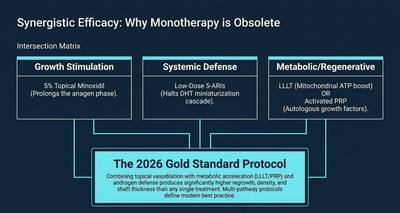
Compare that with the established baseline the deck describes. Topical minoxidil at 5% and 2% is the universal baseline therapy, rated moderate-to-high on efficacy ceiling with scalp irritation as its risk. Oral finasteride at 1 mg is systemic DHT suppression, rated high, with a hormonal risk flag. LLLT at 635–655 nm activates ATP and cytochrome c oxidase and is rated high with no systemic risk, at +18.4 to +25.7 hairs/cm² at 26 weeks and +39% hair count in males versus +37% in females. The pipeline is trying to beat those numbers on locality, not merely on magnitude.
| Treatment | Delivery | Efficacy ceiling | Systemic effect risk | Quantified result |
|---|---|---|---|---|
| Dutasteride mesotherapy 0.05% | Localised injection | Very high | Minimal | +75.5 hairs/cm² at 24 weeks |
| Oral finasteride 1 mg | Systemic oral | High | Hormonal | None listed |
| Oral dutasteride 0.5 mg | Systemic oral | High | Not listed | None listed |
| LLLT 650 nm | Device / topical light | High | None | +25.7 hairs/cm²; +39% males, +37% females |
| Activated PRP | Injection | Moderate (density only) | Injection site | Density only, no caliber change |
| Topical minoxidil 5% | Topical | Moderate-high | Scalp irritation | None listed |
| Agent | Stated timepoint | What is actually measured |
|---|---|---|
| Dutasteride mesotherapy 0.05% | 24 weeks | Hair count: +75.5 hairs/cm² |
| LLLT 635-655 nm | 26 weeks | Hair count: +18.4 to +25.7 hairs/cm² |
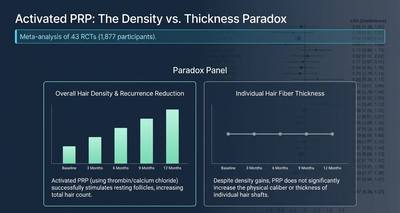
| Activated PRP | Baseline to 12 months | Density and recurrence reduction (0.77 [0.67, 0.93]) |
| ABS-201 | Phase 1/2a trials | Stage only; no endpoint listed |
| Cosmerna (SAMiRNA-AR68) | Cosmetic | No endpoint listed |
How to Read Pipeline Data Without Overreading It
Three rules keep a pipeline slide useful. First, match the timepoint: 24 weeks for mesotherapy, 26 weeks for LLLT, and 12 months for the PRP density endpoint are not interchangeable horizons, and a number without its timepoint is not a result. Second, check whether the figure is a hair count or a stage label — only one candidate on this slide has the former. Third, hold the evidence class constant: the PRP arm rests on a meta-analysis of 43 RCTs covering 1,877 participants while the deck synthesises 40+ RCTs and meta-analyses overall, and Phase 1/2a data does not sit at that level. The clinical regrowth science review applies the same discipline to the approved agents.
For an Irvine or California patient reading this alongside an appointment, the practical translation is that mesotherapy is the one pipeline entry with a number you can compare, while ABS-201 and Cosmerna are targets rather than outcomes. The decision tools and the frequently asked questions are the places to check how such candidates get slotted against approved therapy before a provider weighs them in a real case.
Frequently Asked Questions
What result is reported for dutasteride mesotherapy?
The slide reports +75.5 hairs/cm² at 24 weeks for the 0.05% formulation, rates its efficacy ceiling very high with minimal systemic effect, and names advanced loss in patients avoiding oral medication as its ideal indication. It is a localised 5-ARI, not the oral 0.5 mg tablet.
Are ABS-201 and Cosmerna approved treatments?
No. The slide places ABS-201, an AI-designed monoclonal antibody against the prolactin receptor pathway, in Phase 1/2a trials, and describes Cosmerna (SAMiRNA-AR68) as an RNAi cosmetic that reduces follicular AR mRNA and blocks the TGF-beta 1 paracrine loop. Neither carries a hair-count endpoint on the slide.
How does the pipeline compare with LLLT on numbers?
LLLT at 635–655 nm reports +18.4 to +25.7 hairs/cm² at 26 weeks, with +39% hair count in males and +37% in females (Harvard DASH and Lanzafame RCTs), and no systemic risk. Mesotherapy's +75.5 hairs/cm² at 24 weeks is the larger movement, but it sits at a much earlier evidence stage. This is educational information, not medical advice, and a qualified provider should assess the individual case.
Get matched with hair restoration professionals →
Ready for a Professional Review?
We can connect you with qualified hair restoration professionals who can map your situation to the right treatment.
Get Matched with Hair Restoration Professionals